Ultra Premium Olive Oil
How to Make Balsamic Reduction Sauce at Home
Aug
A good balsamic reduction has a way of making an ordinary plate look and taste considered. A ribbon over roasted vegetables, a few drops on ripe strawberries, or a glossy finish on grilled chicken brings sweet-tart depth without adding another complicated component. To make balsamic reduction sauce, you need very little equipment, but the vinegar you choose and the moment you stop cooking make all the difference.
This is less a recipe than a small kitchen technique worth learning. Start with a balsamic vinegar whose flavor you enjoy before it ever reaches the pan. Reduction concentrates everything in the bottle: the fruitiness, acidity, sweetness, and any harsh edges too.
What a balsamic reduction really is
Balsamic reduction sauce, sometimes called balsamic glaze, is balsamic vinegar gently simmered until some of its water evaporates and its natural sugars become concentrated. The result is thicker, sweeter, darker, and more syrupy than the original vinegar.
A traditional reduction needs no added sugar, honey, or cornstarch. Balsamic vinegar already contains enough natural sweetness to create a beautifully balanced drizzle. That said, there are times when a small addition makes sense. If you are working with a very sharp, inexpensive vinegar or want a dessert-style sauce, a teaspoon or two of honey can round the flavor. It will also cause the mixture to thicken faster, so watch it closely.
The finished sauce should not taste like candy. Its appeal comes from contrast: bright acidity beneath dark-fruit sweetness, with enough body to cling to food instead of disappearing across the plate.
Choose balsamic vinegar you would happily taste
The bottle matters because reduction magnifies its character. A quality dark balsamic vinegar with balanced acidity and notes of fig, cherry, raisin, or oak will make a reduction with more dimension than a flat, aggressively acidic grocery-store vinegar.
For a classic, versatile sauce, choose a traditional-style dark balsamic. It is especially lovely with roasted squash, tomatoes, pork, steak, fresh mozzarella, Parmesan, and berries. A flavored dark balsamic can be even more expressive when you have a particular pairing in mind. Blackberry-Ginger balsamic makes a striking glaze for duck or grilled peaches; Fig balsamic is natural with lamb and blue cheese; Pomegranate-Quince brings brightness to roasted carrots and winter salads.
Avoid reducing an already thick commercial glaze. Those products are often formulated with sweeteners or thickeners and can become cloying or scorch easily. Also, save very rare, long-aged balsamic for finishing. Its concentrated complexity is best appreciated by the drop, not simmered away in a saucepan.
At Weyira Olive Oil & Vinegar, tasting is part of choosing well: if the vinegar is balanced enough to sip, it has the foundation for a memorable reduction.
How to make balsamic reduction sauce
Use a small, nonreactive saucepan, a silicone spatula or spoon, and one cup of balsamic vinegar. A saucepan with a light interior can make it easier to judge the color and thickness, but it is not essential.
Pour in the vinegar and bring it just to a gentle simmer over medium heat. Once you see small, steady bubbles, lower the heat to medium-low or low. You want quiet evaporation, not a rolling boil. Fast boiling can make the vinegar taste sharp and can turn a nearly perfect sauce bitter in minutes.
Let the vinegar simmer uncovered, stirring occasionally at first and more often as it reduces. One cup usually becomes about one-quarter cup of sauce in 15 to 25 minutes, though the exact time depends on your pan width, burner, and the vinegar itself. A wide skillet exposes more surface area and finishes faster; a narrow saucepan takes longer but gives you a little more control.
Begin checking carefully once the liquid has reduced by about half. Dip a spoon into the sauce and run a finger across the back after it cools for a moment. When the line holds briefly, the sauce is approaching the right stage. Another reliable test is to place a small drop on a cool plate. It should look glossy and move slowly, but it should still be looser than your ideal final drizzle.
Remove the pan from the heat a little early. Balsamic reduction thickens significantly as it cools. What seems slightly thin and pourable in the hot pan often becomes exactly right at room temperature.
The texture to aim for
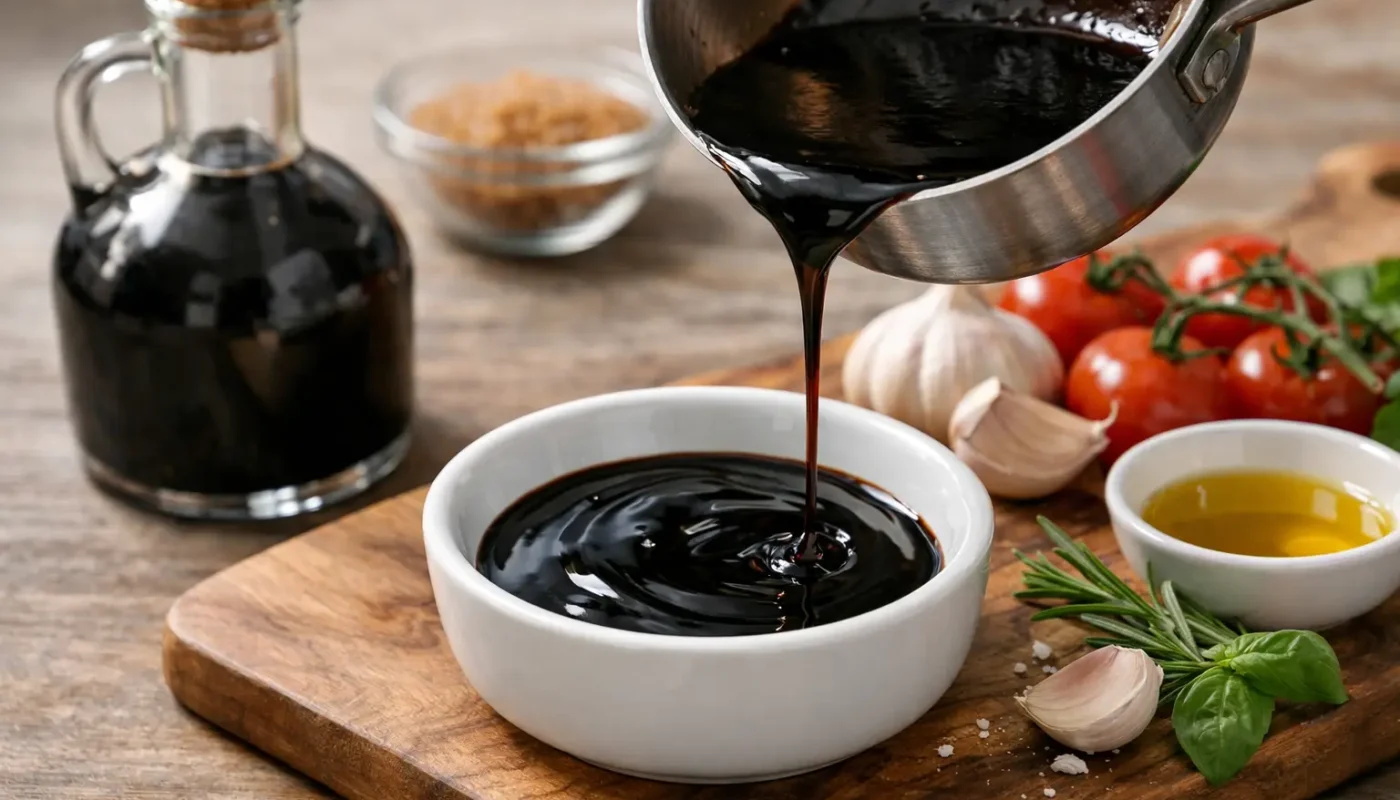
Think warm maple syrup, not caramel. A finished reduction should fall from a spoon in a slow, continuous ribbon. It should be thick enough to make defined lines over a plate, yet fluid enough to drizzle without coaxing.
If it turns tacky, gummy, or hardens into a candy-like layer on the spoon, it has gone too far. Return it to the pan with a tablespoon of warm water and stir over low heat until smooth. You may need another small splash. The flavor will be slightly more concentrated than intended, but the sauce is usually very recoverable.
If the reduction is still thin after cooling, simply return it to low heat for a few more minutes. This is why patience is more useful than a strict timer.
Small choices that improve the result
Keep the pan uncovered. A lid traps moisture and slows the process, while an uncovered pan lets you see how the bubbles change as the sauce thickens. Early in cooking, bubbles are small and lively. Near the end, they become slower, larger, and glossier.
Do not walk away during the last five minutes. Sugar-rich liquids can go from silky to burnt quickly, particularly in a small pan. If you smell anything bitter, acrid, or like dark caramel, take the pan off the heat at once.
You can add aromatics, but use restraint. A strip of orange peel, a lightly crushed rosemary sprig, or a few black peppercorns can be infused while the vinegar reduces. Remove them before storing. Garlic is less dependable here because its flavor can become sharp and distracting as the liquid concentrates.
Salt is optional and depends on the dish. A tiny pinch can sharpen a savory glaze for steak or mushrooms, but leave a reduction unsalted if you plan to use it with fruit, cheese, or desserts. It is easier to season the finished plate than to correct the whole batch.
Where to use balsamic reduction
This sauce earns its place because it works across the meal, from appetizer board to dessert. Its sweetness pairs naturally with creamy, salty, rich, or charred foods, while its acidity keeps those foods from feeling heavy.
For a simple starter, drizzle it over fresh mozzarella, tomatoes, basil, and a generous pour of extra virgin olive oil. The olive oil matters here: a fresh, peppery EVOO gives the reduction a savory counterpoint and turns a familiar Caprese into something more vibrant.
For dinner, use it after cooking, not as a high-heat grill sauce. Brush a little on sliced steak, pork tenderloin, grilled chicken, salmon, portobello mushrooms, or roasted Brussels sprouts just before serving. Applied too early over intense heat, the sugars can burn.
On a cheese board, it is excellent with aged cheddar, goat cheese, blue cheese, and Parmigiano-Reggiano. Add pears, figs, toasted nuts, or a spoonful of honey for an easy, polished spread. A few drops also transform a bowl of strawberries, vanilla ice cream, grilled peaches, or a flourless chocolate cake.
Storing and fixing your sauce
Cool the reduction completely, then transfer it to a clean glass jar or squeeze bottle. Refrigerate it with a tight-fitting lid and use it within two to three weeks for the freshest flavor. If it thickens in the refrigerator, let it stand at room temperature for 10 to 15 minutes or warm the bottle briefly in a bowl of warm water.
Never judge the sauce only while it is piping hot. A reduction that seems perfect straight off the stove can become far too thick by the time dinner reaches the table. Make it a little ahead, taste it once cool, and adjust with a few drops of water if needed.
The next time your roasted vegetables need more than salt and oil, or your cheese board needs a finishing touch, make a small batch. One good vinegar, gentle heat, and a patient eye are enough to bring restaurant-worthy contrast to the foods already in your kitchen.
